H E R E B E G I N N E T H
THE FIRST BOOK OF THE
STEGANOGRAPHIA OF JOHANNES TRITHEMIUS
Abbot of Sponheim, of the Order of St. Benedict,
in the Diocese of Mainz,
T O
THE MOST SERENE PRINCE,
LORD PHILIP, COUNT PALATINE
of the Rhine, Duke of Bavaria, Prince Elector
of the Sacred Empire, etc.
 T is the opinion of the learned that whenever the ancient sages, whom in the Greek language we call Philosophers, discovered any secret of art or nature, they concealed it through various modes and figures lest the knowledge of it should fall into the hands of the wicked. That even Moses, the famed leader of the Israelite race, in his description of the creation of Heaven and Earth, concealed with simple words the ineffable arcana of these mysteries, all the scholars of the Jews confirm. Amongst our own, the divine and learned Jerome affirms that there are almost as many mysteries lying hidden in the Apocalypse of John as there are words. The wise men of the Greeks, held in not small esteem by their fellows, I shall pass over. I will likewise omit our erudite philosophers and poets who, through a deeply wise invention, endeavored when composing their fables to relate in a single narration one thing to the ignorant and another to the learned. And even though I myself, on account of the slowness of my abilities, am not able to imitate fully these studious lovers of Wisdom, nevertheless I admire them and, insofar as I am able, do not omit to read them with diligence. For when I consider the grand things that these men beyond all others have conceived through their studies, I begin to chafe with a certain vehemence until I grow warm and I force myself toward some emulation of my predecessors, even the most recent ones. And this dispostion has not, I belive, entirely failed me since through constant reading I have learned many things that I had not known before and through my cogitations I have unlocked a door to the investigation of secrets that are utterly hidden to others. For even though I am neither so learned nor industrious as to dare profess that I have grasped fully the method of the ancient sages for concealing mysteries, nevertheless, I have uncovered certain ways, both numerous and varied, that are not (so it seems to me) to be entirely spurned whereby I can intimate my most secret thoughts to another who knows this art, however far away I wish, securely and free from the deceit, suspicion, or detection by anyone, using writing or openly through messengers. The new discovery of this most secret art I have committed to writing at the insistence of the Most Serene Prince, Lord Philip, Count Palatine of the Rhine, Duke of Bavaria and Prince Elector of the Holy Roman Empire and a most wise Maecenas to all philosophers. There did not seem to me anyone more worthy than him to whom this great secret should be revealed and it is not without supreme effort that I have compiled the volume before you. But lest this great secret should reach the ears of the ignorant masses or wicked men, I judged it to be not the last accounting of my duty to envelope it in mysteries since it teaches the unknowing to understand mysteries. And I did this in such a way that no one from the number of the ignorant (no one unless he is most studious) will by his own power be able to penetrate completely the arcana of this new science to the full extent of our meaning — unless, that is, through its direct reception from a teacher, what the Hebrews call Cabala which is preeminent among the occult mysteries. Nor is it the case that the knowledge of this secret art, divulged to the wicked and perverse, would harm the State less than it would benefit were it divulged to good men. For just as good men and those who have a zeal for virtue put every discovery to a good and communal use, thus do evil and perverse men hunt opportunities to corrupt not only what was established for evil, but also what had been established as good and sacred. Somthing similar can happen to our secret discovery which is otherwise honest and useful to the State. For just as it offers itself as an instrument for good in the hands of good and holy men, so does it present itself to the impious and the perverted as an aid to their crimes. And just as a good man and a lover of honesty may for his private benefit or the public good notify, express and intimate his secret intentions to another who knows this art, at whatever distance, at any time, whenever and however often he wishes, securely, secretly and free from the suspicion of any mortal man, completely, copiously and fully, whether through messages that are overt and open to all or through sealed missives (such that no one, however clever or attentive could suspect anything of the sender’s secret, nor, even if he did suspect, could he detect anything) — so too will every slithering pervert and criminal, as soon as he acquires this art, start writing well-composed letters in Latin, even if he was entirely ignorant of the Latin language beforehand (which if I taught him he could pick up in at most two days); these letters could be narrations about anything, open to anyone, elegant and well-adorned, addressed either to me or to someone esle who is skilled in this art in which, with a Cabalistic power, he can enshroud his secret intentions — accessible to me alone — in mysteries so great that absolutely no one, however studious or clever, will be able penetrate them without the spirits that belong to this art which I shall soon describe. Letters of this sort can be written by the educated and the ignorant, men and women, the young and the old, the good and the bad, the chaste and the licentious, in Latin or in whatever language of whatever clime of the globe they know, using the Latin, Greek or a barbarian alphabet, in which they can express overtly, and free from all suspicion, one thing to those who do not know this art and something esle covertly to those who know. Nor would the trust between a husband and wife, though ratified by sacrament, remain safe if this knowledge were made public amongst scoundrels. For a married woman, though she may be ignorant of Latin, can nevertheless fully discern the wicked and shameless intentions of her adulterous lover in the chaste, honest and holy words he has written to her in any language whatsoever and in a fairly educated style. And it may be her husband himself who brings her the letter while praising its goodness. And she can convey her desires back to him securely in the same way, as broadly and expansively as she wishes, in the same or another letter, in beautiful and quite ornate sentences. For though this knowledge is good in and of itself and quite useful to the State, nevertheless if it reached the attention of twisted men (God forbid), over time the whole order of the State would become disturbed, and not in a small way. Public trust would be in peril. Every letter, document and writ, and even people’s very conversations would fall under the gravest suspicion. No one without trepidation would believe anything written, however holy and honest. Seldom would anyone put their trust in a letter since however honest and chaste the words, one would always think some trickery, fraud or deception was underneath. People would become fearful of everyone and in general suspicious of their friends no less than their enemies. Nor could anyone, even if he lived a thousand years with his teacher, become so learned and expert in this science that there would not still remain infinite ways of writing secretly, covertly and securely with this same art – ways sufficient for every operation that can be devised at the whim of any other expert – which he and his instructor have yet to learn. For just as the good and bad aerial spirits created by God on high to assist and profit us (through an understanding of which, all the secrets of this art are revealed) are infinite beyond number and utterly incomprehensible, so likewise all the ways, methods, distinctions, characteristics and operations of this our art which we call Steganography (which keeps secrets and arcana and mysteries completely safe from exposure to any mortal, however studious or clever) cannot be accessed in full. This science is a chaos of infinite depth which no one can comprehend completely. For however expert and adept you may be in this art, you will always have learned less than what you do not know. This most deep and secret art has the property that it easily makes the student incomparably more learned than his teacher, as I have said, provided that he is disposed by nature to advance and that he is diligent in what he has learned in the Cabalistic tradition. And lest there be some reader of this work who, while proceeding through it, should take offense at the frequent names, offices, ranks, distinctions, properties, prayers and any of the other operations of the spirits by whose intelligences1 all the secrets of this science are sealed and opened, believing or assuming that I am a necromancer and a magus, or that I have entered into a pact with demons, or that I have used or use any superstition whatsoever, I deemed it necessary and opportune to preempt this by vindicating with the truth my name and reputation from so great a blemish, outrage, fault and stain by means of a solemn protestation in this prologue.


 ACB
ACB 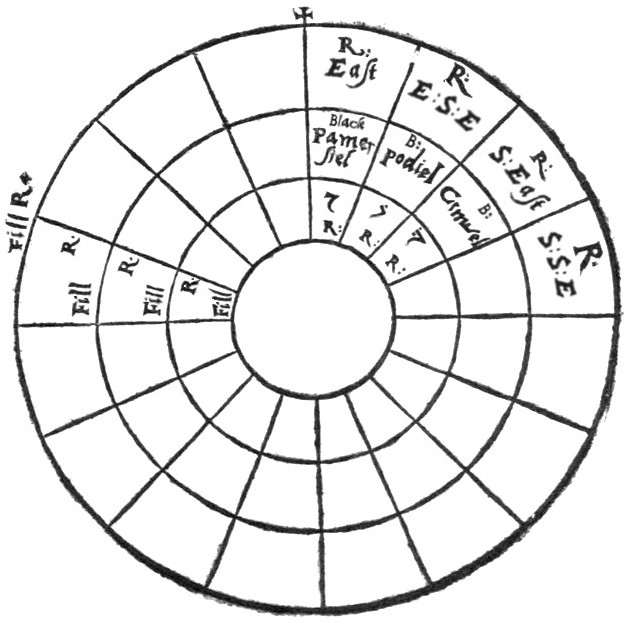


 He has beneath him thirty who preside during the day and who have great authority to chase away spirits of the darkness. Subordinate to these are another thirty who preside during the night and who abide always in the dark and never come into the light except at the command of their princes to whom they are at all times subject. And these in turn have beneath them others who are like guards and attendants subject by full oath. Sometimes thirty, sometimes twenty, sometimes ten, and sometimes all of them together at the same time sally forth at the command of their princes in this order: namely, that however many of them from the second or third rank are summoned by an operator who has great powers at his command, the same number of guards and subservients will come with them to their prince, who is Malgaras. Again, beneath these are others such as messengers and porters of uncertain number who often come intermixed with them. We do not have the names of all of these spirits. But that which is necessary for the operator to know we shall express in its appropriate chapter. And note that all of these spirits, together with their prince-commander (whoever it may be) are in the sector of the world that is assigned to them, as is clear from the table.
 Bradford H Sievert

 Mark Stillman
  John
John  VR
VR 
𝕽. [rot] & 𝕾 [ſchwarz]?
Interesting question! I thought about that too, namely, are these nouns here or adjectives, and to what extent did 16th century German rigidly adhere to the capitalization rules used in modern German? I opted for capitalization, especially since they are capitalized in the text. I’ve enjoyed using the “long-s” (ſ) glyph where appropriate, but I also want to make sure the text remains searchable, so finding a suitable balance has required some thought. I’d like to make a blog-post on this topic sometime soon. Thanks for your attention to detail!